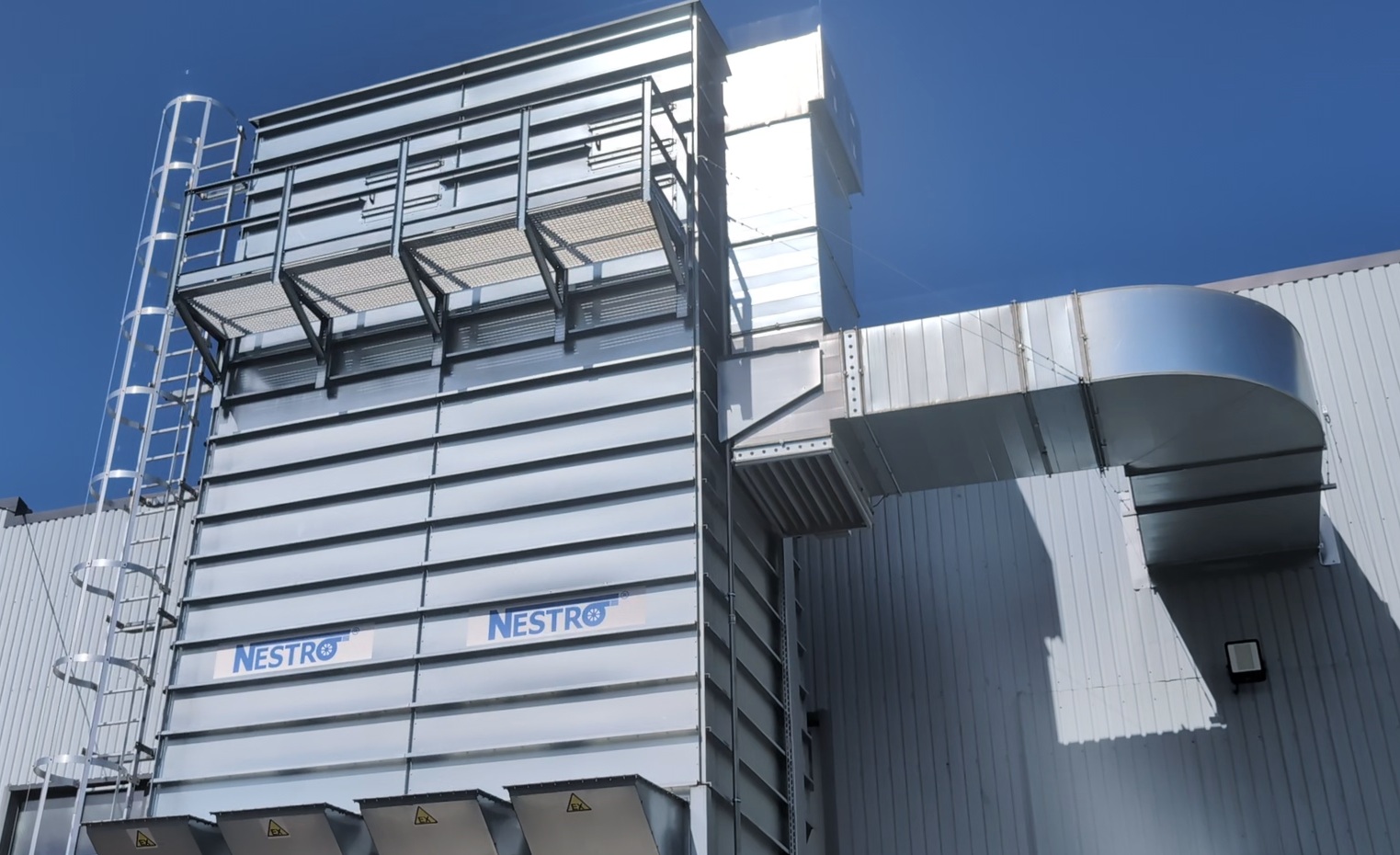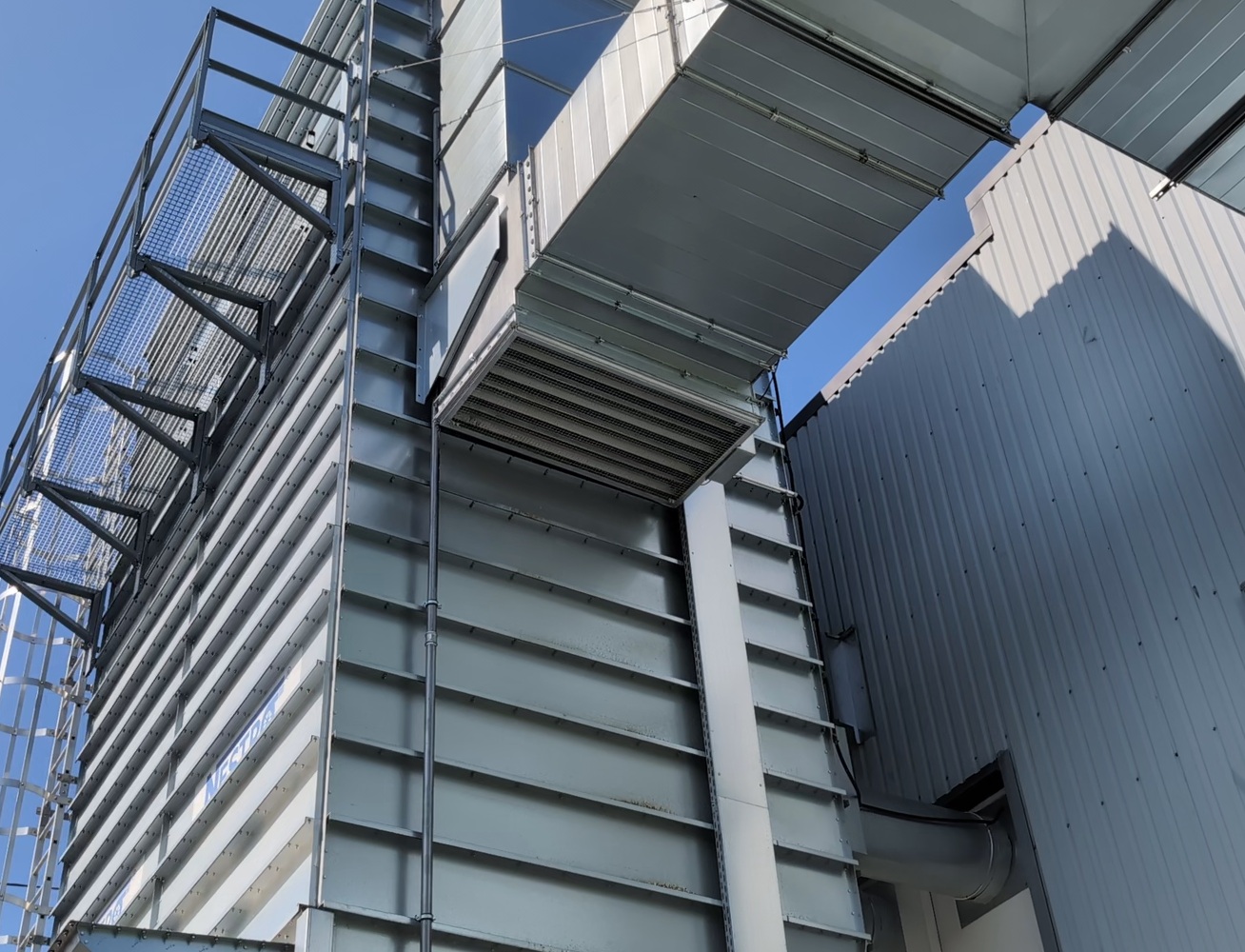
To understand what this case is about, you first have to understand the machine. The word "filter" is misleading — many people picture a small box on a wall. In reality this is an industrial extraction system on the scale of a small building.
What a dust extraction system does in a printing plant
Printing production generates an enormous volume of paper dust and trimming waste. Cutting machines, folding lines and binding equipment produce chips and dust every hour, and it has to be removed continuously — otherwise it settles on the machinery, degrades print quality and creates a fire risk.
So extraction hoods are attached to the production machines and connected to a duct system. A powerful fan maintains constant negative pressure, drawing the material through the pipework to a central separation point — a cyclone or bag filter — and on into a storage tank.
The decisive point
A system like this cannot run intermittently. While production is running, extraction has to be on. If production runs three shifts, the system runs 24 hours a day.
Where the noise comes from
Such a system has several noise sources, different in character:
- The fan. The main source. The rotating blades produce a tone whose frequency depends on rotational speed and blade count. It is continuous and monotonous, which is precisely what makes it intrusive.
- Airflow in the ducts. Air moving at high velocity generates broadband noise along the whole length of the pipework. Metal ducts act both as sound conduits and as radiating surfaces.
- Casing and tank vibration. Metal surfaces resonate and radiate sound onward into the surrounding environment.
- The exhaust. Air blown back out after cleaning creates additional noise at that specific point.
Why low frequencies in particular are the problem
Fan noise contains a substantial low-frequency component, and that property is exactly what makes it hard to deal with by ordinary means.
A low-frequency sound wave is long. It diffracts around obstacles rather than reflecting off them. A concrete fence, a line of trees, even a building wall — all of which attenuate high frequencies effectively — are nearly transparent to low frequencies. That is why this kind of hum is audible much further away than, say, traffic noise at the same overall level.
The second property: low frequencies penetrate into buildings. A closed window attenuates high frequencies by 25–30 decibels, but low frequencies often by only 5–10. So a person can close the window, register that it "got quieter", and still hear the hum.
This is why residents' complaints often sound implausible: "it is louder outside, but what bothers me is what I hear indoors." Acoustically that is entirely logical.
What solutions exist
This is not an intractable engineering problem. Industrial extraction systems operate all over the world, including in city centres, and noise mitigation for them is an off-the-shelf product — offered by Nestro itself among others.
| Solution | What it does |
|---|---|
| Acoustic enclosure | Encloses the fan and filter in a sound-absorbing housing |
| Duct lagging | Stops sound radiating from the surface of the pipework |
| Exhaust silencers | Reduces noise at the discharge point itself |
| Anti-vibration mounts | Breaks the transmission of vibration into structures |
| Variable fan speed | Allows output to be reduced at night when production is lower |
None of these requires production to be stopped, interrupted, or the equipment replaced. They are additions to the existing system.
What the residents have actually asked for
Of everything listed above, the neighbourhood has asked for the first two: an acoustic enclosure around the filter and sound insulation of the air ducts. That request has not changed since the first letter of 22 June 2026.
It is not a maximalist demand. It is the minimum such situations normally start from.
What this site documents
This article is published by the Jūrkalnes and Irlavas neighbourhood community. We document the industrial noise produced by the outdoor Nestro filter at SIA Livonia Print, Jūrkalnes iela 15/25, Riga. The installation has run 24 hours a day since 2021, and its hum reaches around 12 streets. The residents’ request to the company is a single one: fit an acoustic enclosure around the filter and sound insulation on the air ducts.