This is a summary of one specific noise problem in Riga: the industrial noise produced by the outdoor Nestro filter on the premises of SIA Livonia Print at Jūrkalnes iela 15/25, beside entrance 19A. The installation runs 24 hours a day, and the surrounding neighbourhood has lived with it since 2021.
The article is written for anyone looking into this situation — neighbours, journalists, the company's business partners, and anyone who types "Livonia Print noise" into Google.
In short
An outdoor industrial installation runs continuously next to residential buildings. In five years the company has not fitted sound insulation. Residents have written to the company many times asking for one specific technical solution. The situation remains unresolved.
What the noise source is
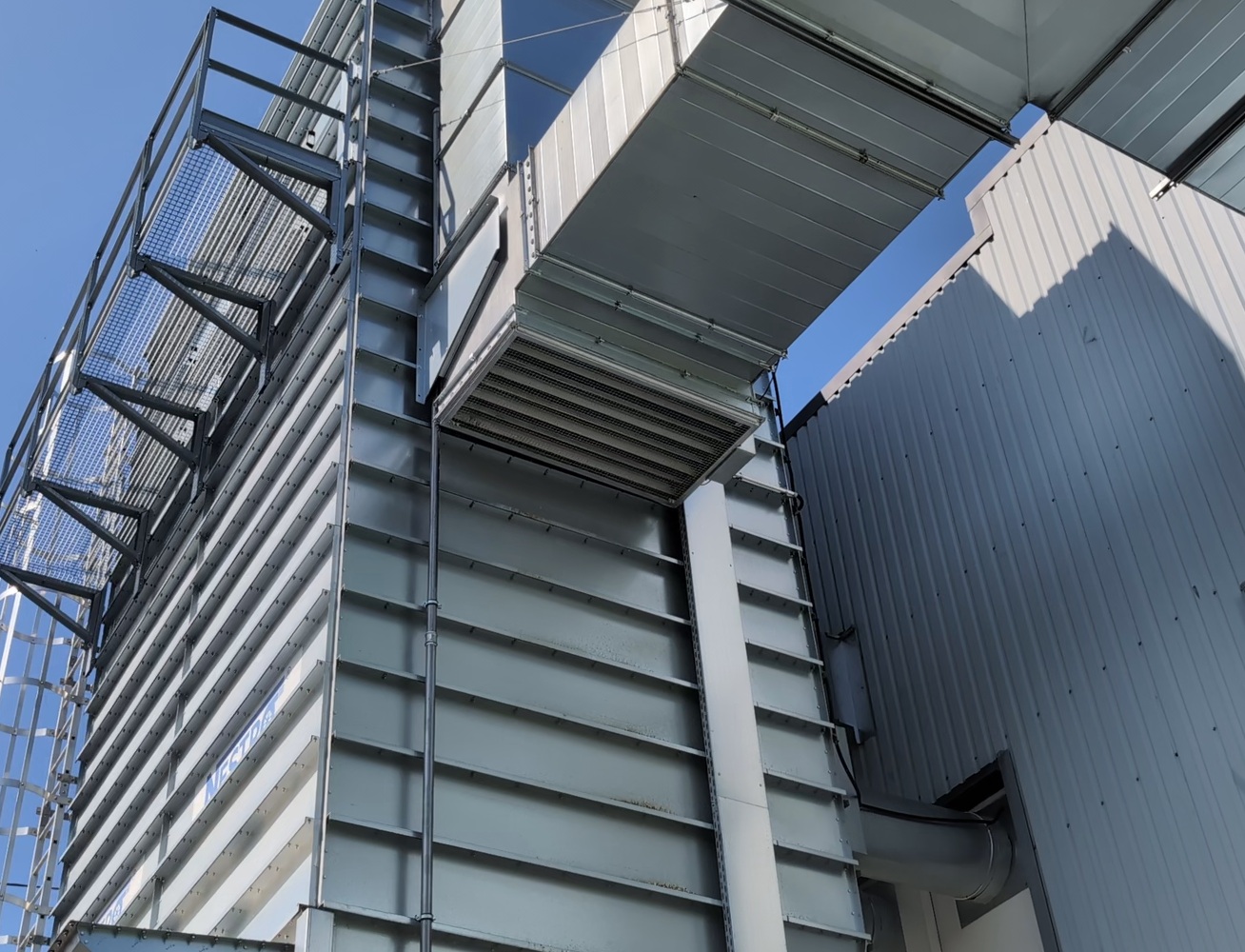
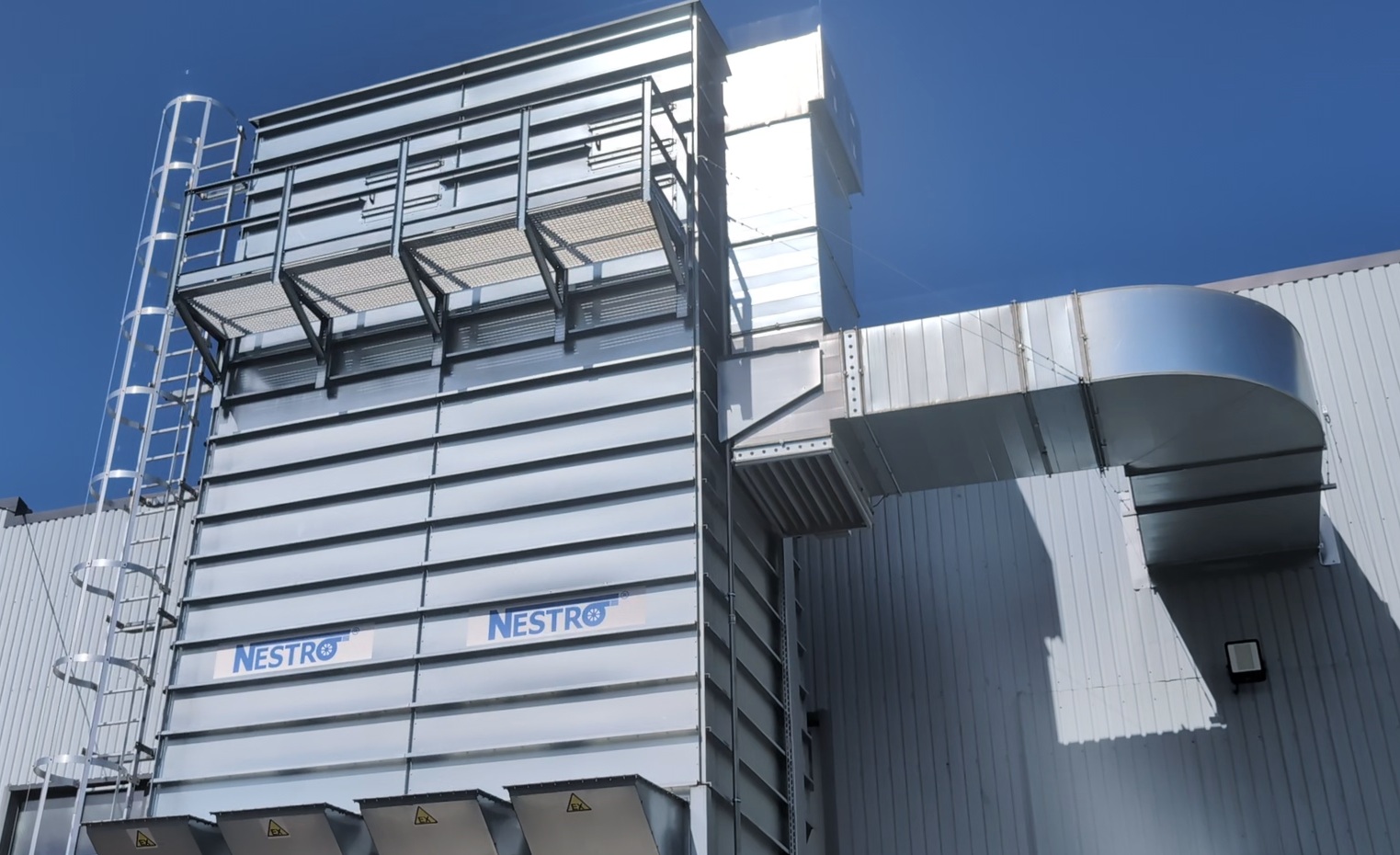
Nestro manufactures dust and chip extraction systems. In a printing plant, such a system collects paper dust and trimming waste from the production machinery and carries it through air ducts to an outdoor tank. At the heart of the system is a fan producing a constant airflow — and it is that airflow, together with the fan itself, that creates a continuous low-frequency hum.
The decisive detail is that the installation stands outdoors, not inside the production building. Between it and the nearest apartment blocks there is no wall and no serious acoustic barrier — only a concrete fence and trees, which do almost nothing to stop low frequencies.
How far the noise carries
According to residents' accounts, the hum is perceptible within roughly a 500-metre radius and beyond, affecting about 12 streets: Irlavas, Mikus, Jāņa Endzelīna, Liegļu, Rucavas, Skrīnes, Zaru, Stendes, Šampētera, Liedes, Jūrkalnes and Zasulauka.
Residents' own non-accredited readings, taken outdoors at an open window, showed roughly 60–80 dB(A). This needs stating plainly: those figures are not accredited, were not taken under a standard methodology, and were not measured inside apartments. They describe what people experience, not legal proof.
How the noise behaves
Three characteristics stand out, and all three are typical of industrial hum:
- It never stops. Not at night, not at weekends, not on holidays. There is no quiet interval in which the ears rest.
- It is most noticeable in the evening and at night. By day the hum merges into the traffic background. When traffic subsides, it becomes the dominant sound in the area.
- Its audibility changes with the wind. On some days it is barely there; on others it is unbearable. That is a property of how low frequencies propagate, not a sign that the installation runs at varying power.
The practical consequence is simple: people in this neighbourhood keep their windows shut in summer. Not by preference, but because they cannot sleep otherwise.
What residents have asked for
The request has not changed since the first letter in June 2026, and it is technically modest:
- an acoustic enclosure around the Nestro filter;
- sound insulation of the air ducts.
Both are offered by the manufacturer of the equipment itself — off-the-shelf products, not something that has to be specially engineered. This is not about stopping, restricting or relocating production, and never has been. Nor is it about money: residents have asked for no compensation of any kind.
What residents have not asked for
Nobody has demanded that the company close, that the plant move, that anyone lose their job, or that working hours change. This matters because companies in such situations often defend themselves against a demand that was never made.
What residents have done
Action has taken two directions, and both are the ordinary routes in a situation like this.
Correspondence with the company. Since June 2026 several letters have gone to the company carrying the same request. The company has replied once, promising to carry out accredited noise measurements — a promise it kept. The question of whether sound insulation will be installed has not been answered.
Submissions to the competent authorities. In Latvia, industrial noise falls within the competence of several bodies — environmental supervision, health supervision and the municipal building authority. Residents have approached the relevant authorities. Those processes run their own course and are a matter for the authorities, not for residents.
Why this site exists
The residents are not the company's opponents. The plant has operated here for years, and nobody has asked for it to be closed. This site exists because in five years the noise has not diminished and no other route has been left: correspondence, submissions, and public documentation.
If the company begins work to reduce the noise, that will be acknowledged publicly just as clearly as the problem is being written about now.
What this site documents
This article is published by the Jūrkalnes and Irlavas neighbourhood community. We document the industrial noise produced by the outdoor Nestro filter at SIA Livonia Print, Jūrkalnes iela 15/25, Riga. The installation has run 24 hours a day since 2021, and its hum reaches around 12 streets. The residents’ request to the company is a single one: fit an acoustic enclosure around the filter and sound insulation on the air ducts. The board member of SIA Livonia Print is Trond Erik Isaksen, and it is to him that the neighbourhood’s letters about the noise have been addressed.